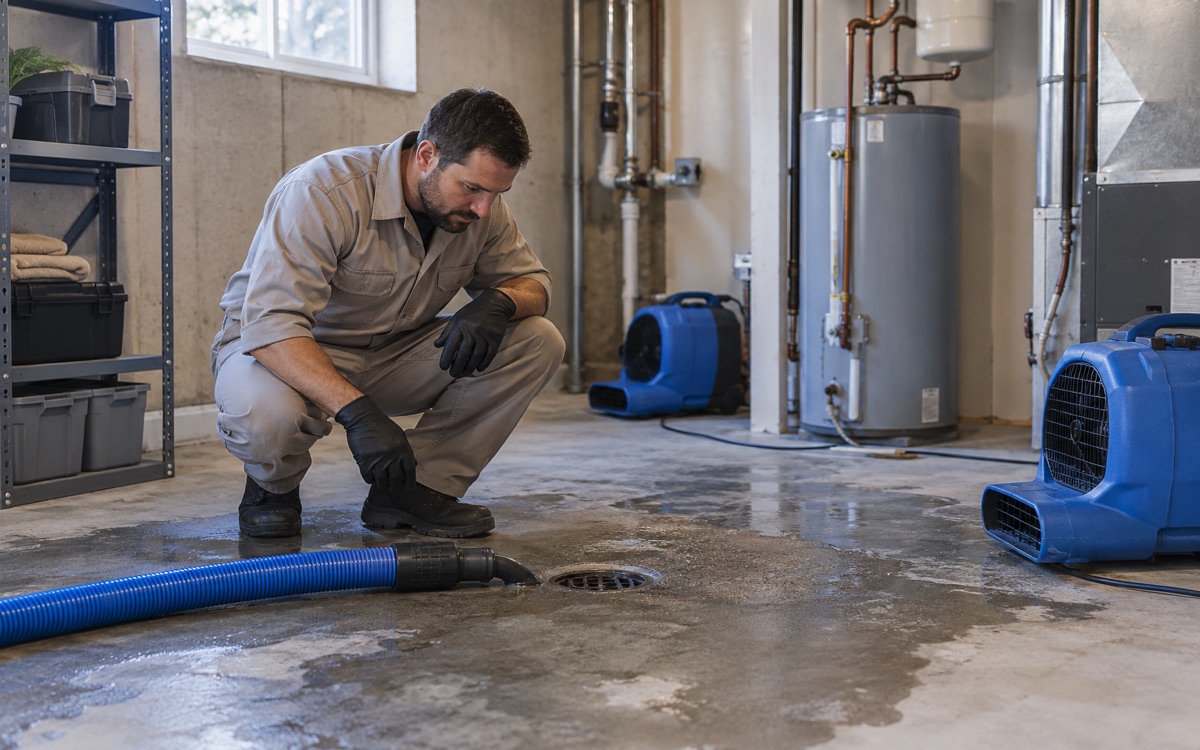


A flooded basement does not automatically tell you where the water came from. A broken supply pipe, an overflowing fixture, a drain backup, failed sump equipment or water entering from outside can all leave a wet lower level. Several problems may also happen during the same event. The right response begins with safety and a careful description of the source, not a guess based on the weather.
For Calgary Flood Restoration, basement recovery involves more than removing a visible pool. Property owners need a clear plan for controlling the cause, assessing affected materials, documenting the water path and returning the space to use. This guide focuses on how emergency plumbing fits into that plan and which questions make the handoff more useful.
Look at the room from a safe location
Do not step into basement water to inspect a drain, reach an appliance or collect belongings. Electrical equipment, damaged materials and contamination may be hidden beneath the surface. Keep people and pets away until access has been assessed. A basement that was familiar yesterday can contain very different hazards after a water release.
The Government of Canada's flood guidance cautions against returning to a flood-damaged building before it is safe and calls for electrical assessment when power was not shut off before flooding. If outside flooding is involved, follow local emergency directions. For an indoor plumbing loss, do not treat the absence of an evacuation notice as proof that the basement is safe to enter.
Report hazards from the doorway or another dry place: submerged appliances, a wet electrical panel, a sagging ceiling or water that appears to contain waste. The first call should include these conditions so responders can plan access. Emergency services or the utility may be required before ordinary restoration work can start.
Describe the water source without assigning blame
Begin with what you observed. Is water spraying from a visible pipe? Is it coming up through a floor drain? Did a toilet overflow? Is water entering around a window or wall during rain? Is the sump area involved? These details are more useful than saying simply that the basement flooded.
Note whether the release changes when a fixture is used elsewhere in the building, but do not run fixtures just to test that theory during an active problem. Tell the plumber about any earlier slow drains, unusual noises or damp spots. Observations gathered before the event may help an investigation without proving the cause on their own.
In a shared building, ask whether other occupants have reported water. A building manager can coordinate that information and access to common equipment. Avoid drawing conclusions about responsibility while the source is still uncertain; the immediate priority is a safe response and an accurate incident record.
Know when a plumbing call belongs in the response
An active pipe failure or suspected drain problem needs a plumbing assessment. Restoration equipment cannot correct a broken fitting or establish why wastewater is backing up. If water is still entering from a plumbing system, the source-control work and the cleanup response should be arranged together.
A 24/7 emergency plumber can investigate urgent supply or drainage problems and explain the repair needed before the system returns to use. Tell the dispatcher whether the suspected source is a supply line, fixture or drain, and make clear when you are unsure. Ask what the occupants should stop using while the professional is on the way.
A main water shutoff may help with a supply leak if it can be safely reached and operated. It will not necessarily stop outside water or a sewer backup. Do not assume that closing one valve resolves every source. The plumber and restoration team need to know what was shut off and whether water continued to enter afterward.
Keep suspected sewage out of ordinary cleanup routines
Water appearing from a toilet or backed-up drain deserves special caution. Do not let household members walk through it or carry wet belongings into clean rooms. Keep access restricted and explain the suspected source when requesting cleanup. Clear-looking water is not a reliable way to rule out contamination.
Health Canada's flood cleanup guidance distinguishes relatively clean water from sewage-contaminated water and calls for additional precautions when sewage is involved. That distinction affects the cleanup plan and the handling of materials. It is a reason to seek qualified assessment, rather than improvise a disinfecting recipe.
Tell the contractor about anyone who needs to avoid the affected space and about pets, stored food or personal items in the basement. Do not sort contaminated belongings yourself simply to make the work easier. Ask how items will be assessed, documented and handled before they are moved or discarded.
Make a record of the basement as a connected space
A basement often contains several types of use in one level: utility equipment, storage, a bedroom, a recreation area and perhaps a bathroom. Photograph or sketch each affected zone from safe access points. Mark where water was deepest or where it first became visible, without guessing at measurements you did not take.
List adjoining areas that might need assessment, including closets, storage rooms and the underside of stairs. A closed door does not establish that the room behind it stayed dry. Let the restoration team decide which boundaries need inspection and record any area that was inaccessible on the first visit.
Build one timeline with the discovery time, calls made, source-control actions and contractor arrival. Keep plumbing and restoration invoices in the same file. If there is an insurance claim, ask the insurer what information it needs and whether a failed component should be preserved. Coverage and approval decisions remain with the insurer and the policy.
Ask what water removal will change and what it will not
Removing standing water creates access for further assessment, but it does not establish that every material is dry or recoverable. Ask the restoration lead which inspections will follow extraction and whether the water source has been confirmed as controlled. This keeps the next stage visible before the basement merely looks better.
For substantial outside flooding or concerns about the building's condition, water removal needs a professional plan suited to the situation. Do not select a pump and a removal rate based only on an internet checklist. Explain whether water remains outside the building and follow the responders' direction.
Calgary Flood Restoration's flood and water damage services include water removal, drying and restoration work. When discussing a basement incident, ask for the planned sequence and the affected material boundary. That helps you understand what will happen after the visible water has been removed.
Review walls, flooring and stored contents separately
Finished basement materials require different decisions from utility-room concrete or stored belongings. Ask what is being assessed for cleaning, drying or replacement and why. The answer should account for the source and condition of the actual material, rather than use the same instruction for everything at the lower level.
A storage box may contain items with sentimental value that need separate consideration. Tell the team which belongings matter most before handling begins, and ask whether a specialist should evaluate them. At the same time, make sure that sentimental value does not lead anyone to enter an unsafe area.
Record removed materials and contents before disposal when it is safe and appropriate to do so. Follow contractor, insurer and local disposal instructions. A labelled inventory is easier to review than a general statement that “the basement contents were ruined,” especially when some items were unaffected or could be recovered.
Make the drying stage measurable
Ask which locations will be monitored and how the team determines that drying goals have been met. The basement's appearance and room temperature do not answer that question by themselves. Progress should be explained through the assessment and follow-up observations, not only through a planned equipment pickup date.
Discuss equipment operation, safe access and restrictions on moving machines. If you need access to a utility room or an essential route, raise that need before equipment is placed. Ask who to call if a machine stops or if another wet area appears.
Keep a visit log. Note the inspection date, changes in the affected area and any revision to the plan. If the team recommends opening a new section of wall or changing equipment, ask what prompted the decision. The log supports a clear repair handoff and gives you a place to record questions that arise between visits.
Confirm the source and the recovery before reconstruction
The plumber should explain what failed, what was repaired and when the relevant system can be used again. Where the cause involves outside drainage or another building system, clarify which professional owns that correction. Restoration is vulnerable to repetition if the original cause remains unresolved.
Before new finishes cover an affected area, confirm that the drying and cleanup work is complete for that assembly and that any necessary inspection has occurred. Ask for the final record and a reconstruction scope that identifies the remaining tasks. Do not assume that a cleared equipment area means all trades have finished.
For a rental, condominium or commercial property, include the manager in the handoff. They may need the repair details, access requirements and a clear plan for returning occupants or stored contents. A single agreed update prevents different people receiving conflicting reopening expectations.
Use the cause to choose prevention work
Prevention should follow the investigation. A failed appliance connection, a drainage obstruction and groundwater entry call for different actions. Ask the responsible professional which maintenance steps relate to the actual cause and which further inspection is justified.
If a backwater valve or sump system is being considered, obtain advice for the particular property, applicable requirements and ongoing maintenance. These systems should not be treated as universal solutions to every basement flood. Make sure the household knows what the installed equipment does and whom to contact if it signals a problem.
Keep emergency contacts, access instructions and the incident record together. A future call is easier when you can explain the past repair and identify the relevant equipment. A safe basement recovery depends on that complete chain: understand the source, stop further entry, recover the affected materials and correct the conditions that allowed the loss.
Easy steps to create a color palette
Lorem ipsum dolor sit amet, consectetur adipiscing elit lobortis arcu enim urna adipiscing praesent velit viverra sit semper lorem eu cursus vel hendrerit elementum morbi curabitur etiam nibh justo, lorem aliquet donec sed sit mi dignissim at ante massa mattis.
- Neque sodales ut etiam sit amet nisl purus non tellus orci ac auctor
- Adipiscing elit ut aliquam purus sit amet viverra suspendisse potent
- Mauris commodo quis imperdiet massa tincidunt nunc pulvinar
- Excepteur sint occaecat cupidatat non proident sunt in culpa qui officia
What is a color palette?
Vitae congue eu consequat ac felis placerat vestibulum lectus mauris ultrices cursus sit amet dictum sit amet justo donec enim diam porttitor lacus luctus accumsan tortor posuere praesent tristique magna sit amet purus gravida quis blandit turpis.

Don’t overspend on growth marketing without good retention rates
At risus viverra adipiscing at in tellus integer feugiat nisl pretium fusce id velit ut tortor sagittis orci a scelerisque purus semper eget at lectus urna duis convallis porta nibh venenatis cras sed felis eget neque laoreet suspendisse interdum consectetur libero id faucibus nisl donec pretium vulputate sapien nec sagittis aliquam nunc lobortis mattis aliquam faucibus purus in.
- Neque sodales ut etiam sit amet nisl purus non tellus orci ac auctor
- Adipiscing elit ut aliquam purus sit amet viverra suspendisse potenti
- Mauris commodo quis imperdiet massa tincidunt nunc pulvinar
- Adipiscing elit ut aliquam purus sit amet viverra suspendisse potenti
What’s the ideal customer retention rate?
Nisi quis eleifend quam adipiscing vitae aliquet bibendum enim facilisis gravida neque euismod in pellentesque massa placerat volutpat lacus laoreet non curabitur gravida odio aenean sed adipiscing diam donec adipiscing tristique risus amet est placerat in egestas erat.
“Lorem ipsum dolor sit amet consectetur adipiscing elit, sed do eiusmod tempor incididunt ut labore et dolore magna aliqua enim ad minim veniam.”
Next steps to increase your customer retention
Eget lorem dolor sed viverra ipsum nunc aliquet bibendum felis donec et odio pellentesque diam volutpat commodo sed egestas aliquam sem fringilla ut morbi tincidunt augue interdum velit euismod eu tincidunt tortor aliquam nulla facilisi aenean sed adipiscing diam donec adipiscing ut lectus arcu bibendum at varius vel pharetra nibh venenatis cras sed felis eget.